50s Men’s Fashion: What Men Wore in the 1950s and How to Wear It Now
What men wore in the 1950s: greaser, Ivy and tailored looks, key pieces, hair and accessories, modern 50s outfits for guys, and 50s party outfits.


We may earn a commission when you buy through links on this page, at no extra cost to you. How we earn money
In this guide
- What Did Men Wear in the 1950s?
- 50s Trends Men Can Still Wear Today
- 1950s Men’s Clothing: Shirts, Pants, Jackets, and Shoes
- 50s Greaser Style
- 50s Preppy and Ivy Style
- 50s Tailoring and Suits
- 50s Casual and Beach Outfits
- 50s Hairstyles, Hats, and Accessories for Men
- How to Dress 50s Style Today: Modern Outfit Ideas
- What to Wear to a 50s Party
- 50s Fashion Mistakes to Avoid
- FAQs
Men in the 1950s wore suits to work and, off duty, leather jackets, white T-shirts, cuffed jeans, knit polos and penny loafers. The 1950s gave men some of the most wearable clothes of any decade: leather jackets, white T-shirts, straight jeans, knit polos, penny loafers, and clean tailoring. This guide covers what actually defined 50s men’s fashion, the key pieces, the hair and accessories, how to wear the look today without it reading as a costume, and what to wear to a 50s party.
Table of Contents
What Did Men Wear in the 1950s?
The 1950s split men’s clothing into two clear worlds: the office and everything else.
At work, men wore suits, almost without exception. Grey flannel became so tied to the corporate man that Sloan Wilson’s 1955 novel The Man in the Gray Flannel Suit, filmed in 1956 with Gregory Peck, turned the phrase into shorthand for the conformist office worker. Early in the decade, suits were full and roomy. By the late 50s, cuts got trimmer, lapels narrowed, and ties got thinner, which set up the sharper tailoring of the early 60s.
Outside work, younger men changed the rules. Marlon Brando wore a black leather motorcycle jacket in The Wild One (1953). James Dean wore a red jacket, white T-shirt, and jeans in Rebel Without a Cause (1955). Both films turned what had been workwear and underwear into a youth uniform, and that uniform has never really gone away.
On college campuses, Ivy style took hold: Oxford button-down shirts, chinos, crew-neck sweaters, cardigans, and penny loafers. In summer and on vacation, men wore camp collar shirts, Hawaiian prints, knit polos, and tailored shorts.
So 50s style is not one look. It is four or five lanes:
- Classic tailoring: grey or navy suits, white shirts, narrow ties, polished shoes.
- Greaser and rock and roll: leather jacket, white tee, cuffed jeans, boots.
- Preppy and Ivy: button-downs, chinos, cardigans, loafers.
- Casual leisure: knit polos, camp collar shirts, pleated trousers.
- Beach and summer: Hawaiian shirts, Bermuda shorts, linen.
50s Trends Men Can Still Wear Today
Most of the 50s works today with very little adjustment. That is rare for a decade.
Wear as-is: White crew-neck T-shirts, straight-leg dark jeans, black or brown leather jackets, Oxford button-down shirts, chinos, crew-neck sweaters, penny loafers, and suede chukka boots. These look normal in any modern setting.
Wear with a modern fit: Pleated trousers, camp collar shirts, knit polos, cardigans, and Harrington-style or blouson jackets. Keep them trim and the right length, and they read as current rather than vintage.
Use carefully: Hawaiian shirts and bold-print camp collars. Fine for summer and holidays. Keep everything else plain.
Party only: Fedoras with a suit, rolled-up jeans with a high cuff and white socks, bow ties with casual outfits, heavy pomade quiffs, and suspenders on show.
1950s Men’s Clothing: Shirts, Pants, Jackets, and Shoes
The key pieces, and how they translate.
Shirts
White T-shirt: The most important 50s item. Plain, crew-neck, heavyweight cotton. It should fit close through the chest and arms, not tight.
Oxford button-down shirt: White, light blue, or pale pink. The Ivy staple and still one of the most useful shirts a man can own.
Camp collar (Cuban collar) shirt: An open, flat collar with a straight hem meant to be worn untucked. Solid colors like cream, rust, or navy are easiest. Rayon and linen versions drape best.
Knit polo: A fine-knit cotton or wool polo, often with a buttoned or open collar. More refined than a pique polo. Navy, cream, brown, and burgundy look the most 50s.
Hawaiian shirt: A summer and vacation piece. Pick darker or muted prints over neon.
Pants
Straight-leg jeans: Dark rinse, straight leg, no distressing. A small single cuff at the hem is the 50s detail. Skip skinny and flared cuts entirely.
Pleated trousers: Higher rise, single or double pleat, with a center crease. Grey flannel, tan, and brown work best.
Chinos: Khaki or stone, flat front or single pleat. More ideas in the khaki pants guide.
Jackets
Leather motorcycle jacket: Black or dark brown, fitted at the body, ending at the waist.
Blouson or Harrington-style jacket: A short, zip-front jacket gathered at the waist. Red, navy, tan, or olive.
Varsity jacket: Wool body, leather or contrast sleeves. Keep the patches minimal.
Sports coat: Tweed or a textured wool in grey, brown, or navy, worn with odd trousers.
Shoes
Penny loafers: G.H. Bass introduced its Weejun penny loafer in 1936, and by the 50s the style was a campus standard. Brown or burgundy leather.
Engineer or work boots: The greaser option. Black or brown leather.
Oxfords and Derbies: For suits. Black for formal, brown for everything else.
Canvas sneakers: Plain low-top or high-top canvas sneakers in white or black.
50s Greaser Style
The greaser look is the 50s at its most recognizable: black leather jacket, white tee, cuffed jeans, and boots. It works today because every piece in it is still a normal piece of clothing.
How to wear it today: Keep the formula, drop the extras. A fitted leather jacket, plain white tee, dark straight jeans, and black boots is a strong everyday outfit with no costume risk. What pushes it into costume is the heavy pomade, the rolled sleeve with a pack of cigarettes, a very high jean cuff, and a comb in the back pocket. The rugged look guide covers how to build more outfits around leather, denim, and boots.
Outfit formula: Black leather jacket + white crew-neck tee + dark straight jeans with a small cuff + black leather boots.
Greaser vs rockabilly
Greaser and rockabilly overlap but aren’t the same. Greaser is the working-class street look of the 50s: leather jacket, white T-shirt, jeans and boots. Rockabilly takes its name from the music of the time, and the rockabilly look leans more on shirts: bowling and western shirts, two-tone details, cuffed jeans and a pompadour. Today, “rockabilly” is also the name of the revival scene, which mixes both.
50s Preppy and Ivy Style
Ivy style came from American college campuses and was built on simple, well-made pieces: Oxford shirts, chinos, crew-neck sweaters, cardigans, tweed sports coats, and loafers.
How to wear it today: This is the easiest 50s lane to adopt, because modern smart casual is largely built on it. Keep the shirt tucked, the chinos slim-straight, and the loafers polished. Add a cardigan or crew-neck sweater in cooler months.
Outfit formula: Light blue Oxford button-down + navy crew-neck sweater + stone chinos + brown penny loafers.
Outfit formula: White Oxford shirt + grey cardigan + grey flannel trousers + burgundy loafers.
50s Tailoring and Suits
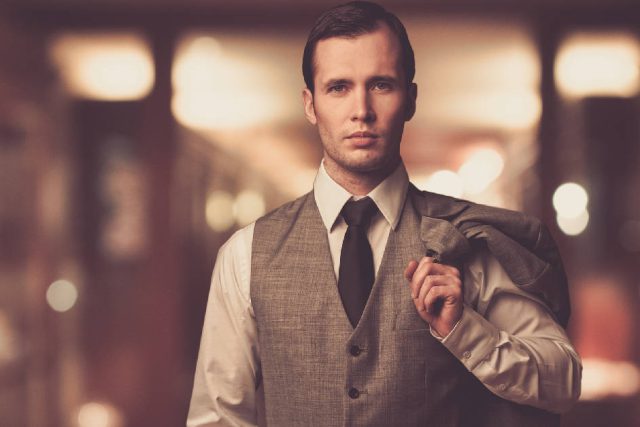
Most 50s men owned a suit and wore it often. Charcoal, grey, and navy dominated, with white shirts and narrow ties. Hats were still common at the start of the decade and became less so as it went on.
How to wear it today: Take the clean lines, not the props. A slim single-breasted suit in charcoal or grey flannel, a white shirt, a narrow navy or black tie, and black Oxfords gives you the 50s feel without looking dressed up for a theme. Skip the fedora unless you already wear hats and know how. A plain black suit with a skinny black tie also reads as late 50s.
Outfit formula: Charcoal suit + white dress shirt + narrow black or navy tie + black cap-toe Oxfords + white pocket square in a flat fold.
For a less formal version, swap the suit for a tweed or grey sports coat with contrasting trousers. The grey blazer guide has more combinations.
50s Casual and Beach Outfits
Weekend and leisure wear in the 50s was relaxed but still neat. Knit polos, camp collar shirts, pleated trousers, and tailored shorts were the core.
Knit polo and pleated trousers: The most refined 50s casual look. The polo is tucked in, the trousers are high-rise and pleated.
Camp collar shirt and linen trousers: Untucked shirt, relaxed linen trousers, loafers or leather sandals.
Hawaiian shirt and shorts: The 50s beach look. Tailored shorts in stone, white, or navy, cut just above the knee.
How to wear it today: Pick one statement piece. If the shirt has a bold print, the shorts and shoes stay plain. Shorts should hit just above the knee. For more summer options, see the men’s summer fashion guide.
Outfit formula: Cream camp collar shirt + navy tailored shorts + brown leather loafers or sandals.
50s Hairstyles, Hats, and Accessories for Men
Hair and small accessories carry a lot of the 50s look, which is why they are the easiest place to overdo it.
- Hair: the pompadour and the quiff (hair swept up and back), the ducktail, the crew cut, the flat top and the neat side part held with pomade or hair tonic. Short back and sides was the default, even under a pompadour.
- Hats: the fedora and the trilby were still everyday hats for men in suits at the start of the decade, and became less common as it went on. See trilby vs fedora for the difference.
- Glasses: browline frames (a heavy top rim with a thin wire below) and thick horn-rimmed frames.
- With a suit: a narrow tie, a tie bar, a white pocket square folded straight across, and a watch on a leather strap.
For a modern 50s look, pick one: a side part with a matte pomade, or browline glasses, or a tie bar. All three together starts to look like a costume. To see which 50s haircut and which glasses frames suit your face, try the face shape detector.
How to Dress 50s Style Today: Modern Outfit Ideas
Use one or two 50s references per outfit. These formulas look current while carrying the decade’s feel.
Everyday casual: White tee + black leather jacket + dark straight jeans + black Chelsea or engineer boots.
Smart casual: Navy knit polo + grey pleated trousers + brown penny loafers. Add a tan Harrington jacket if it is cool.
Summer: Rust camp collar shirt + cream linen trousers + tan suede loafers.
Weekend: Light blue Oxford shirt + grey cardigan + stone chinos + white canvas sneakers.
Date night: Black knit polo + charcoal trousers + black loafers. Simple and sharp.
Office: White Oxford shirt + tweed sports coat + grey trousers + brown Derbies.
The 50s pieces in these outfits are also core capsule wardrobe items, so they keep working long after a retro phase.
What to Wear to a 50s Party
At a themed event you can push it further. Two outfits are the most recognizable.
Greaser: Black leather jacket + white tee + cuffed dark jeans + black boots. Add slicked-back hair or a pompadour. This is the easiest 50s party outfit to put together because you likely own most of it.
Smart 50s: Grey or navy suit + white shirt + narrow tie + black Oxfords. Add a fedora if you want, but this is the one place it fits.
Ivy alternative: Varsity jacket + white Oxford shirt + chinos + penny loafers with white socks.
Avoid mixing in other decades. Bell-bottoms, tie-dye, and platform shoes belong to the late 60s and 70s, not the 50s. If a theme spans several decades, the 60s men’s fashion guide and 70s men’s fashion guide cover those looks.
50s Fashion Mistakes to Avoid
Wearing it head to toe: Leather jacket, quiff, rolled cuffs, white socks, and a fedora at once reads as fancy dress. One or two vintage references per outfit is enough.
Overdoing hats: A fedora with jeans and a T-shirt looks forced. Hats belong with tailoring, and even then they are optional.
Novelty bow ties and suspenders: Both lean costume fast. Use them only for a party or a formal event that calls for them.
Wrong trouser shapes: Skinny jeans and flares are both wrong for a 50s look. Straight leg is the shape.
Baggy or sloppy tees: The 50s T-shirt was plain and fitted. A slouchy, oversized tee changes the whole look.
Novelty shoes: Two-tone saddle shoes and creepers are hard to wear outside a theme. Loafers, boots, and plain sneakers do the job.
FAQs
What hairstyles did men have in the 1950s?
The most common men’s hairstyles in the 1950s were the pompadour, the quiff, the ducktail, the crew cut, the flat top and the side part, usually held in place with pomade or hair tonic. The sides and back were kept short.
What did men wear in the 50s?
At work, men wore suits in grey, charcoal, or navy with white shirts and narrow ties. Casual clothes included white T-shirts, straight jeans, leather jackets, Oxford button-down shirts, chinos, knit polos, and camp collar shirts. Penny loafers, Oxfords, and work boots were the main shoes.
What are the biggest 50s fashion trends for men?
The leather jacket and white T-shirt, straight cuffed jeans, Ivy style (button-downs, chinos, cardigans), knit polos, camp collar and Hawaiian shirts, pleated trousers, and penny loafers. In tailoring, trimmer suits and narrow ties took over as the decade went on.
How do men dress 50s without looking like a costume?
Use one 50s piece at a time and keep the fit clean. A knit polo with pleated trousers, or a leather jacket with a white tee and straight jeans, carries the decade without looking themed. Skip the hats, heavy pomade, and visible suspenders.
What should men wear to a 50s party?
The greaser look is the easiest: black leather jacket, white tee, cuffed jeans, and boots. For something smarter, wear a slim grey suit with a narrow tie and black Oxfords. A varsity jacket with chinos and loafers works for an Ivy take.
What is 50s greaser style?
Greaser style was a working-class youth look built on leather motorcycle jackets, white T-shirts, cuffed jeans, and boots, with slicked-back hair. Films like The Wild One (1953) and Rebel Without a Cause (1955) helped make the leather jacket, tee, and jeans combination famous.
Were penny loafers popular in the 50s?
Yes. G.H. Bass introduced its Weejun penny loafer in 1936, and by the 50s loafers were a fixture of Ivy and campus style. They remain one of the easiest 50s pieces to wear today.
What 50s trends are wearable today?
Almost all of the casual pieces: white tees, leather jackets, straight jeans, Oxford shirts, chinos, knit polos, camp collar shirts, cardigans, and penny loafers. Pleated trousers also work with a modern fit. Fedoras, bow ties, and creepers are best saved for themed events.